
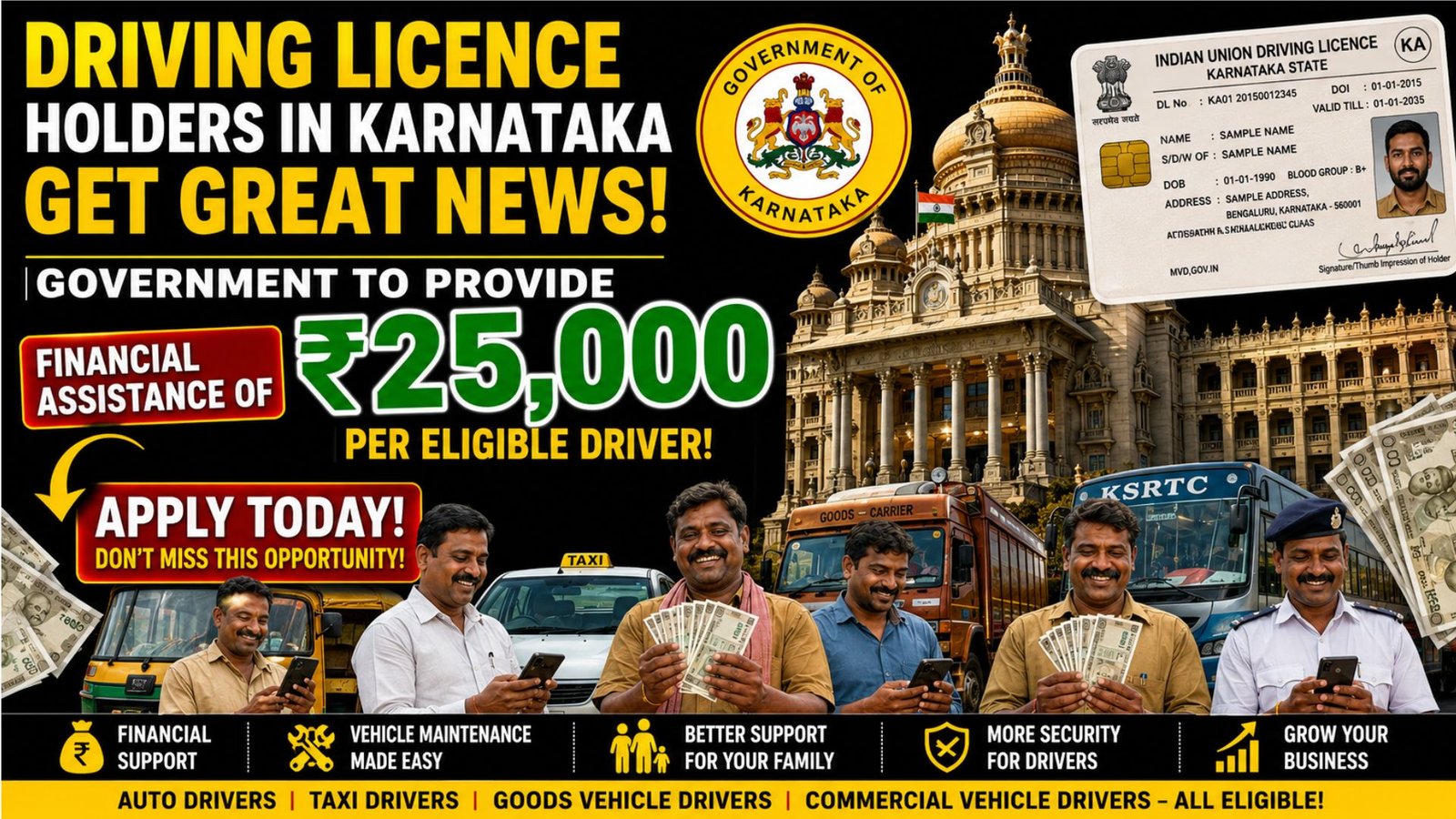
DL Scheme ₹25,000 Subsidy for Drivers in Karnataka
Complete Guide
Documents Required if Such a Scheme is Officially Announced
Whenever the Karnataka Government launches any financial assistance scheme, applicants are generally required to submit specific documents to verify their identity, eligibility, and profession. Although the rumored ₹25,000 subsidy scheme has not been officially announced, the following documents would most likely be required if such a scheme becomes available.
1. Aadhaar Card
The Aadhaar Card serves as the primary identity proof for applicants. It is also linked with the Direct Benefit Transfer (DBT) system through which government subsidies are transferred directly to beneficiaries’ bank accounts.
2. Valid Driving Licence
A valid Driving Licence (DL) is one of the most essential documents. It proves that the applicant is legally authorized to drive and belongs to the category of beneficiaries intended under the scheme.
The licence should be:
- Valid and active
- Issued by a competent transport authority
- Appropriate for the category of vehicle being driven
3. Vehicle Registration Certificate (RC)
Applicants who own commercial vehicles may have to submit the Registration Certificate (RC) to verify ownership and vehicle details.
4. Bank Account Details
Applicants would generally need to provide:
- Bank Passbook
- Account Number
- IFSC Code
This enables the government to transfer financial assistance directly into the applicant’s account.
5. Passport Size Photograph
Recent passport-sized photographs may be required while submitting online or offline applications.
6. Mobile Number
A registered mobile number is important for:
- OTP verification
- Application updates
- SMS notifications
- Status tracking
7. Residential Proof
Applicants may have to submit any one of the following:
- Aadhaar Card
- Voter ID
- Electricity Bill
- Ration Card
- Residence Certificate
This confirms that the applicant is a permanent resident of Karnataka.
8. Income Certificate
Some welfare schemes include income limits. Therefore, applicants may have to provide an income certificate issued by the competent authority.
9. Caste Certificate (If Applicable)
If the government provides special benefits to reserved categories, applicants may need to submit a valid caste certificate.
10. Commercial Vehicle Permit
Drivers operating commercial transport services may also need to upload valid permits issued by the Regional Transport Office (RTO).
How to Apply if the Government Announces the Scheme
As of now, there is no official application process because the ₹25,000 driver subsidy scheme has not been announced by the Karnataka Government.
However, if such a scheme is introduced in the future, the application process may follow these steps.
Step 1: Visit the Official Government Website
Applicants should visit the official Karnataka Government portal or the concerned department’s website.
Never rely on unknown websites or social media links.
Step 2: Read the Official Notification Carefully
Before applying, candidates should carefully read:
- Eligibility conditions
- Required documents
- Last date
- Application procedure
- Financial assistance details
Reading the notification helps avoid mistakes during the application process.
Step 3: Register Yourself
Create an account using:
- Mobile number
- Aadhaar number
- Email ID
Complete OTP verification before proceeding.
Step 4: Login
Use the generated User ID and Password to access the application portal.
Step 5: Fill the Application Form
Applicants may need to provide:
- Personal details
- Address
- Aadhaar details
- Driving Licence number
- Vehicle information
- Occupation details
- Bank account information
Ensure all information matches official documents.
Step 6: Upload Documents
Scan and upload all necessary documents in the prescribed format.
Typical file requirements include:
- JPEG
- PNG
Step 7: Review the Application
Double-check every detail before submission.
Incorrect information may result in rejection.
Step 8: Submit the Application
After verification, click the Submit button.
Save the acknowledgment receipt for future reference.
Step 9: Track Application Status
Applicants can check their application status online using:
- Application Number
- Registered Mobile Number
- Aadhaar Number
Step 10: Receive Financial Assistance
If approved, the subsidy would be transferred directly to the beneficiary’s bank account through Direct Benefit Transfer (DBT).
Benefits Drivers Could Receive if Such a Scheme Is Implemented
If Karnataka officially launches a ₹25,000 subsidy scheme, it could provide significant support to thousands of commercial drivers.
Some possible benefits include:
Financial Stability
Many drivers earn daily wages. A one-time financial grant would help stabilize their finances during difficult periods.
Vehicle Maintenance Support
Commercial vehicles require regular maintenance, including:
- Engine servicing
- Oil changes
- Brake repairs
- Tire replacement
- Battery replacement
The subsidy could reduce these maintenance costs.
Fuel Expense Assistance
Fuel prices continue to fluctuate.
Financial support could help drivers manage:
- Diesel expenses
- Petrol expenses
- CNG costs
- LPG costs
Loan Repayment
Many commercial vehicle owners purchase vehicles through bank loans.
Government assistance could help repay:
- EMI installments
- Interest payments
- Outstanding vehicle loans
Family Welfare
Additional financial support could help families meet expenses such as:
- Children’s education
- Medical treatment
- Household groceries
- Rent
- Utility bills
Increased Confidence Among Drivers
Government welfare schemes often improve confidence among workers by providing financial security during uncertain times.
Reduced Financial Stress
Unexpected expenses often create financial burdens.
A subsidy could provide relief from:
- Vehicle breakdowns
- Medical emergencies
- Seasonal income loss
Encouragement for Self-Employment
Many unemployed youth hesitate to enter the transport industry because of financial constraints.
Government assistance could encourage:
- New taxi operators
- Auto-rickshaw drivers
- Goods transport businesses
- Small commercial vehicle owners
Common Mistakes to Avoid While Applying
Applicants should avoid these common mistakes whenever applying for government welfare schemes.
Providing Incorrect Details
Incorrect personal information may lead to application rejection.
Uploading Blurred Documents
Ensure scanned copies are clear and readable.
Missing Deadlines
Late applications are generally not accepted.
Visiting Fake Websites
Always use only official government portals.
Avoid unknown websites claiming instant approval.
Believing Social Media Rumors
Many misleading messages circulate online claiming:
- Instant approval
- Guaranteed subsidy
- Registration fees
- Fast-track processing
Applicants should ignore such misinformation.
How to Verify Whether a Government Scheme Is Genuine
Before believing any viral message, citizens should verify the information using reliable sources.
Official Government Websites
Always check announcements published on official government portals.
Department Notifications
Visit the concerned transport or welfare department’s website.
Press Releases
Government press releases provide authentic information regarding newly launched schemes.
District Administration Offices
Local district offices can also confirm whether a scheme is active.
Helpline Numbers
Government helpline centers provide accurate information regarding eligibility and application procedures.
Why Fake Government Scheme Messages Spread Quickly
Social media platforms make it easy for information to spread rapidly.
Unfortunately, false claims also travel just as quickly.
Common reasons include:
- Attractive financial benefits
- Emotional headlines
- Forwarded WhatsApp messages
- Edited images
- Clickbait YouTube videos
- Fake websites
Therefore, citizens should verify every government-related announcement before sharing it with others.
Importance of Fact-Checking Before Applying
Fact-checking helps citizens:
- Save time
- Avoid fraud
- Protect personal information
- Prevent financial scams
- Submit genuine applications only
Whenever a new welfare scheme appears online, checking official government sources should be the first step.