
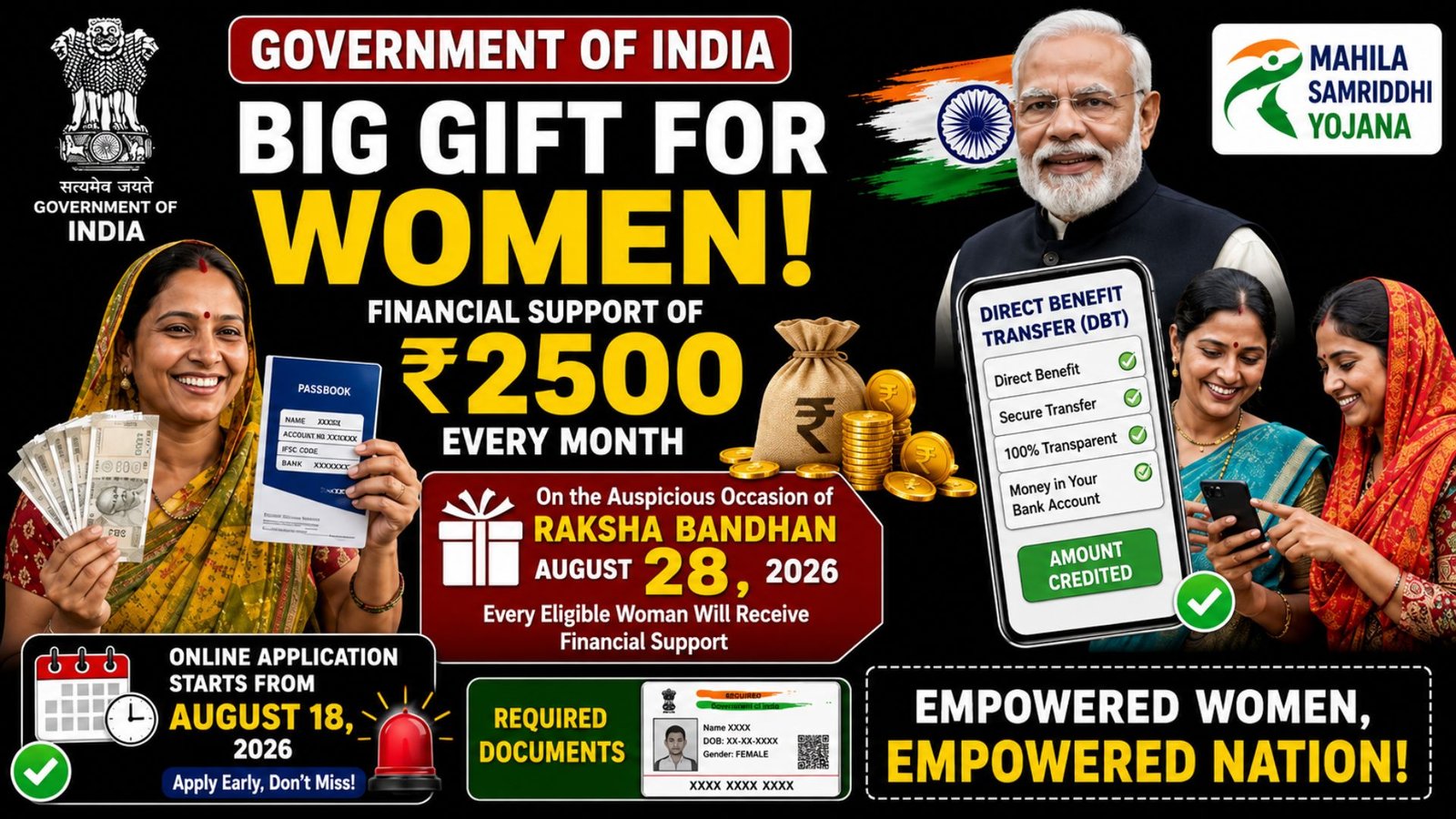
MSY ₹2,500 Monthly Scheme for Women
Fact Check, Eligibility, Benefits, Application Process, and Latest Update
In recent weeks, a viral claim has been circulating across social media platforms, WhatsApp groups, Facebook pages, YouTube videos, and various online news portals stating that the Central Government of India has introduced a new financial assistance scheme under which every eligible woman will receive ₹2,500 every month directly into her bank account. According to these claims, the announcement is expected to coincide with Raksha Bandhan on August 28, 2026, and the financial support will continue every month as part of a women-centric welfare initiative.
The news has quickly attracted the attention of millions of women across the country. Many individuals are eager to know whether the scheme is genuine, who is eligible, how to apply, what documents are required, and when the financial assistance will begin.
Since the information has spread rapidly on social media, many people are finding it difficult to distinguish between verified government announcements and unconfirmed online claims. This has created confusion among citizens, especially women belonging to economically weaker sections who are hoping to benefit from such financial assistance.
This article provides a detailed explanation of the viral claim, discusses the objectives behind similar women empowerment initiatives, examines the eligibility criteria being circulated online, explains the claimed application process, and most importantly presents the official fact-check regarding the authenticity of the ₹2,500 monthly assistance scheme.
Fact Check: Is the Central Government Really Giving ₹2,500 Every Month to Women?
Before discussing the scheme in detail, it is important to understand the most crucial point.
As of now, there is NO official announcement from the Government of India confirming a nationwide Monthly Support Scheme (MSY) that deposits ₹2,500 every month into every eligible woman’s bank account.
Several social media posts have claimed that women will begin receiving monthly financial assistance starting from Raksha Bandhan. However, these claims have not been verified by any official government notification, gazette publication, or press release.
Government welfare schemes are officially announced through:
- Press Information Bureau (PIB)
- Official Government Ministries
- Government Gazette Notifications
- Official Government Websites
- State Government Portals
At present, none of these official sources has confirmed the existence of such a nationwide monthly assistance program.
Therefore, readers should treat these claims carefully and avoid sharing or believing unverified information until an official notification is issued.
Why Did This News Become Viral?
The claim became popular because financial assistance schemes for women have been introduced by several state governments in recent years.
Examples include:
- Monthly financial assistance programs for women in different states.
- Women empowerment schemes.
- Direct Benefit Transfer (DBT) initiatives.
- Self-help group financial support.
- Subsidy schemes for women entrepreneurs.
Since many governments have launched welfare programs for women, people assumed that a similar nationwide scheme had also been introduced by the Central Government.
Unfortunately, misinformation spreads quickly on social media, especially when it relates to financial benefits.
As a result, thousands of people began forwarding messages without verifying the information.
What Is Being Claimed Online?
According to the viral posts, the alleged Monthly Support Scheme (MSY) includes the following features:
- Every eligible woman will receive ₹2,500 every month.
- Payments will be credited directly into beneficiaries’ bank accounts.
- The scheme will begin on Raksha Bandhan.
- Women belonging to economically weaker families will receive priority.
- Applications can be submitted online.
- Aadhaar-linked bank accounts will receive Direct Benefit Transfer (DBT).
- Women can use the assistance for household expenses, children’s education, healthcare, and savings.
Although these claims sound attractive, there is currently no official confirmation supporting them.
Why Financial Assistance Schemes for Women Are Important
Even though the viral MSY claim remains unverified, financial assistance programs for women have become an important part of India’s welfare policies.
Women play multiple roles in society.
They contribute to:
- Household management
- Agriculture
- Small businesses
- Education
- Healthcare
- Self-help groups
- Entrepreneurship
- Government services
- Private sector employment
Despite these contributions, many women continue to face financial challenges.
Common issues include:
- Limited income opportunities
- Wage inequality
- Lack of employment
- Limited access to banking
- Financial dependency
- Rising household expenses
- Educational costs
- Medical expenses
Government welfare programs are often designed to reduce these challenges by providing direct financial assistance, skill development opportunities, subsidized loans, and entrepreneurship support.
Background Behind Women Empowerment Schemes
Women’s empowerment has become one of the major priorities of both the Central Government and State Governments.
Over the past decade, several initiatives have focused on improving:
- Financial independence
- Education
- Healthcare
- Entrepreneurship
- Digital literacy
- Employment opportunities
- Self-employment
- Social security
Various ministries regularly introduce schemes aimed at improving the socio-economic status of women.
These initiatives generally focus on:
- Rural women
- Urban poor
- Widows
- Single women
- Women entrepreneurs
- Self-help groups
- Pregnant women
- Mothers
- Girl children
The primary objective is to create long-term economic stability rather than short-term assistance.
Understanding Direct Benefit Transfer (DBT)
One reason why the ₹2,500 monthly scheme appeared believable is because India already uses the Direct Benefit Transfer (DBT) system for several welfare programs.
Under DBT:
- Financial assistance is transferred directly into beneficiaries’ bank accounts.
- Middlemen are eliminated.
- Leakages in welfare distribution are reduced.
- Transparency improves.
- Payments become faster.
- Beneficiaries receive funds securely.
Because many existing government schemes use DBT, people assumed the viral MSY claim was another such initiative.
However, the payment mechanism alone does not confirm the existence of a new scheme.
Objectives Claimed for the Viral MSY Scheme
According to social media discussions, the proposed objectives of the alleged scheme include:
1. Improving Women’s Financial Independence
The primary objective is said to be providing women with a regular monthly income so that they can manage their personal expenses independently.
Financial independence enables women to make better decisions regarding:
- Education
- Healthcare
- Nutrition
- Household spending
- Children’s welfare
- Savings
Although this objective aligns with many existing government policies, the specific ₹2,500 monthly scheme remains unofficial.
2. Supporting Low-Income Families
The viral posts suggest that economically weaker families would receive priority.
Regular financial support could help families manage:
- Grocery expenses
- Electricity bills
- School fees
- Medical expenses
- Transportation
- Household necessities
Such assistance can reduce financial stress among vulnerable households.
Again, these are claimed objectives rather than officially announced features.
3. Encouraging Women’s Savings
Another commonly circulated objective is encouraging women to save a portion of the monthly assistance.
Savings help families during:
- Medical emergencies
- Educational expenses
- Seasonal unemployment
- Crop failures
- Natural disasters
- Unexpected household expenses
Many successful welfare programs promote financial inclusion alongside savings.
4. Improving Children’s Education
Financial support for mothers often directly benefits children’s education.
Additional household income can help cover expenses such as:
- School uniforms
- Books
- Tuition fees
- Transportation
- Stationery
- Digital learning resources
Research consistently shows that financial support directed to women often results in improved outcomes for children.
5. Strengthening Women’s Decision-Making Power
Economic independence enhances confidence.
Women with stable financial resources are generally better positioned to participate in household financial decisions.
They may have greater flexibility to:
- Start small businesses
- Invest in skill development
- Purchase essential goods
- Save for future needs
- Support children’s education
These broader goals are commonly associated with women-focused welfare initiatives.
Importance of Women’s Financial Empowerment
Financial empowerment extends beyond receiving money.
It includes:
- Access to banking services
- Digital financial literacy
- Credit opportunities
- Insurance coverage
- Pension benefits
- Entrepreneurship support
- Investment awareness
Empowered women contribute significantly to national development.
Studies indicate that improving women’s financial participation strengthens local economies and promotes inclusive growth.
For this reason, governments frequently introduce schemes focused on women’s welfare.
Why Citizens Should Verify Government Schemes
In today’s digital world, misinformation spreads rapidly.
Many fake government scheme announcements include:
- Attractive financial benefits
- False application deadlines
- Fake registration links
- Misleading eligibility criteria
- Unverified logos
- Edited government documents
Citizens should always verify information before applying or sharing it.
Reliable sources include:
- Official ministry websites
- Government press releases
- Official social media accounts
- District administration websites
- Common Service Centres (CSCs)
- Press Information Bureau (PIB)
Avoid submitting personal information or paying fees through unofficial websites claiming to offer registration for unverified schemes.
Current Status of the ₹2,500 Monthly Assistance Claim
Based on the information available as of now:
- No official notification has been issued by the Government of India.
- No ministry has announced such a nationwide monthly assistance scheme.
- No official registration portal has been launched.
- No confirmed beneficiary list has been released.
- No government circular has verified the viral claim.
Therefore, the information currently circulating online should be treated as unverified until an official announcement is made.