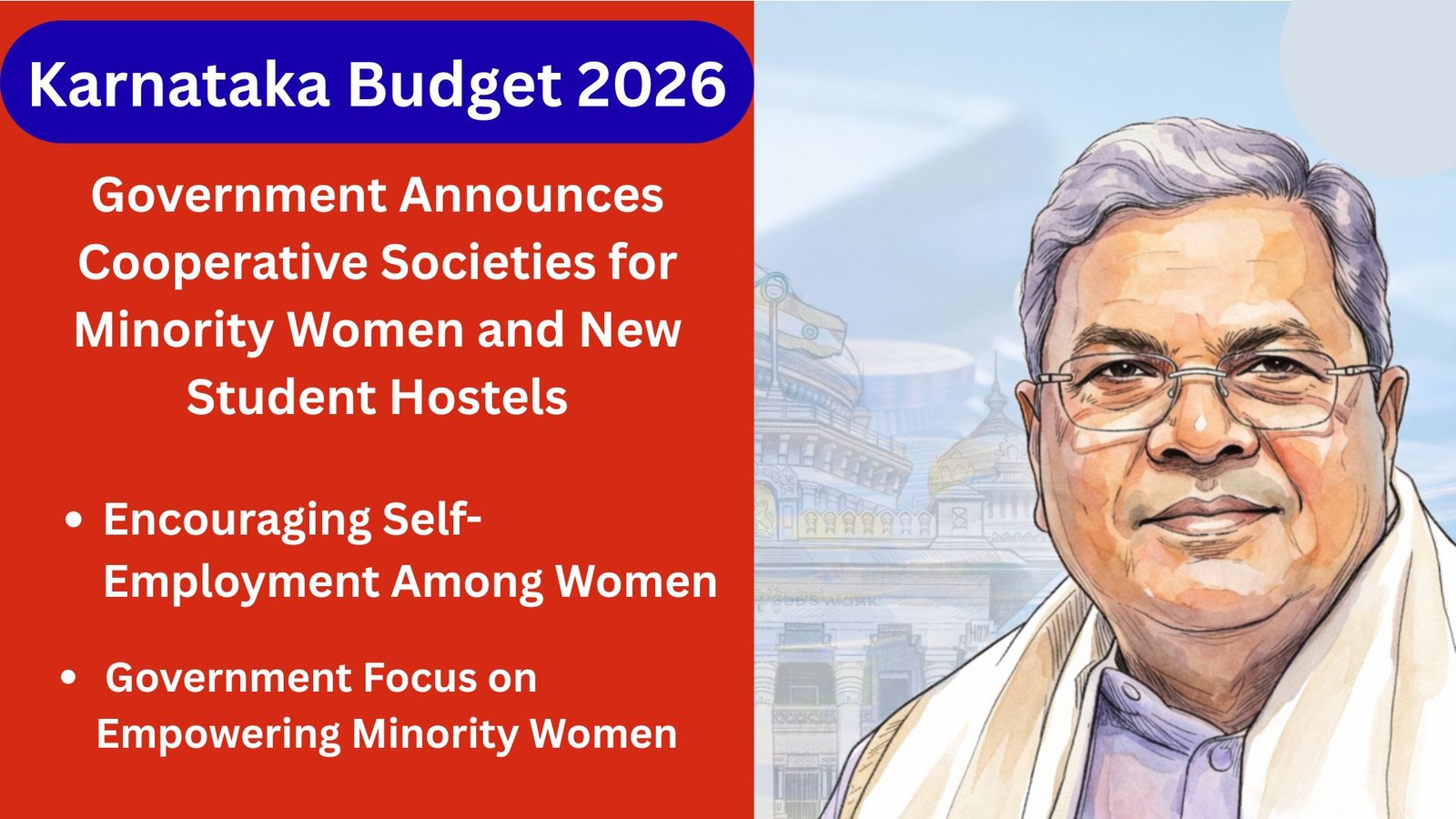
Karnataka Budget 2026
Government Announces Cooperative Societies for Minority Women and New Student Hostels
The Karnataka Budget 2026 introduced several welfare measures aimed at empowering marginalized communities, improving access to education, and strengthening economic opportunities for women belonging to minority groups. Among the key highlights of the budget is the state government’s decision to establish cooperative societies specifically for minority women. This initiative is expected to support women who are part of self-help groups (SHGs) and encourage them to start their own businesses and become financially independent.
Along with this initiative, the government has also announced the creation of new post-matric hostels for minority students in districts where the demand for educational facilities remains high. These measures are designed to create a more inclusive development model that ensures education, employment opportunities, and economic participation for minority communities across the state.
This article provides a detailed overview of the Karnataka Budget announcements related to minority welfare, the significance of cooperative societies for women, the development of hostels for students, and the potential impact of these initiatives on society.
Government Focus on Empowering Minority Women
One of the most notable announcements in the Karnataka Budget 2026 is the government’s plan to establish Minority Women Cooperative Societies. These societies are expected to play a crucial role in strengthening the financial and social position of women belonging to minority communities.
In many parts of Karnataka, women from minority groups actively participate in self-help groups where they collectively save money, access small loans, and support each other in starting small businesses. However, many of these groups still struggle with limited financial support, lack of market access, and inadequate institutional backing.
By creating cooperative societies, the government aims to provide a structured platform where these women can collaborate, pool resources, and expand their economic activities. Cooperative societies also offer legal recognition, better financial access, and improved opportunities for growth.
The initiative reflects the government’s broader vision of promoting women-led economic development and ensuring that women from marginalized communities receive equal opportunities to succeed.
What Are Minority Women Cooperative Societies?
Cooperative societies are organizations owned and operated by a group of individuals who share common economic goals. In the case of minority women cooperative societies, the members will primarily be women belonging to minority communities such as Muslims, Christians, Jains, Buddhists, and others recognized under minority welfare programs.
These societies function on the principle of collective ownership and democratic decision-making, where each member has a voice in the management and operations.
The cooperative societies proposed in the Karnataka Budget will focus on supporting women who want to engage in activities such as:
-
Small-scale manufacturing
-
Handicrafts and traditional arts
-
Food processing
-
Retail businesses
-
Tailoring and garment production
-
Agricultural and dairy activities
-
Online businesses and digital services
Through these activities, the government hopes to create sustainable livelihood opportunities that allow women to contribute to their household income and improve their overall quality of life.
Encouraging Self-Employment Among Women
Self-employment has become one of the most effective ways to promote economic independence among women. Many women in rural and semi-urban areas possess valuable skills but often lack the financial support or infrastructure required to convert these skills into income-generating ventures.
The establishment of minority women cooperative societies is expected to address these challenges in several ways.
First, the societies will help women gain access to credit and financial assistance through government programs and cooperative banking systems. Access to funding is essential for purchasing raw materials, equipment, or other resources required to start or expand businesses.
Second, the societies will facilitate training programs and skill development workshops that help women enhance their capabilities. These programs may include entrepreneurship training, financial literacy, digital marketing skills, and modern production techniques.
Third, cooperative societies will create collective marketing opportunities, allowing members to sell their products more effectively and reach larger markets.
By encouraging self-employment, the government aims to create a new generation of women entrepreneurs who can drive economic growth within their communities.
Strengthening Self-Help Groups
Self-help groups (SHGs) have already played a significant role in promoting financial inclusion among women in India. Thousands of women across Karnataka participate in SHGs, where they contribute small savings and provide loans to members when needed.
However, many SHGs face limitations when it comes to expanding their activities or entering larger markets. The new cooperative societies announced in the Karnataka Budget are expected to build upon the existing SHG framework and provide additional institutional support.
By integrating SHGs into cooperative societies, the government hopes to create stronger economic networks that allow women to scale up their businesses and achieve long-term financial stability.
Education Initiatives for Minority Students
Apart from women empowerment, the Karnataka Budget 2026 also focuses on improving educational infrastructure for minority students. Education remains one of the most important tools for social mobility, and the government has recognized the need to provide better facilities for students from disadvantaged backgrounds.
The budget proposes the establishment of 25 new post-matric hostels in districts where the demand for student accommodation is particularly high. Each of these hostels will have a capacity of around 150 students, ensuring that more students can access safe and affordable housing while pursuing their education.
Hostels play a vital role in supporting students who travel from rural or remote areas to cities for higher studies. Without proper accommodation, many students struggle to continue their education due to financial or logistical challenges.
By building new hostels, the government aims to remove these barriers and encourage more students from minority communities to pursue higher education.
Upgrading Existing Hostel Facilities
In addition to constructing new hostels, the government has also announced plans to improve and upgrade existing student hostels that are currently functioning across the state.
Many of these hostels have been serving students for several years and require modernization and better facilities. Upgrading these hostels will ensure that students receive a safe, comfortable, and supportive environment that allows them to focus on their studies.
Improved hostel facilities may include:
-
Better accommodation infrastructure
-
Modern study rooms and libraries
-
Improved sanitation and hygiene facilities
-
Nutritious meal programs
-
Enhanced security systems
Such improvements will significantly enhance the overall educational experience of students residing in these hostels.
Support for Morarji Desai Residential Schools
Another important aspect of the budget involves the continued support and development of Morarji Desai Residential Schools, which provide quality education to students from minority communities.
These residential schools offer students access to academic resources, extracurricular activities, and a supportive learning environment. By strengthening these institutions, the government hopes to ensure that students receive a well-rounded education that prepares them for future opportunities.
The budget also emphasizes the importance of expanding educational infrastructure and improving learning outcomes among minority students.
Government’s Commitment to Inclusive Development
The initiatives announced in the Karnataka Budget reflect the government’s commitment to inclusive development. By focusing on minority welfare, women empowerment, and educational access, the government aims to ensure that every section of society has the opportunity to participate in economic growth.
Inclusive development means addressing the specific challenges faced by marginalized communities and providing targeted support that helps them overcome these obstacles.
Programs such as minority women cooperative societies and new student hostels demonstrate the government’s recognition of these challenges and its determination to create solutions that promote equality and opportunity.
Potential Impact on Minority Communities
The establishment of cooperative societies for minority women has the potential to create significant positive change within communities.
When women gain financial independence, the benefits extend beyond individual households. Families experience improved living standards, children receive better education, and communities become more economically stable.
Similarly, improved access to education through new hostels and better infrastructure can help students achieve higher academic success and pursue careers that were previously out of reach.
Over time, these initiatives can contribute to reducing poverty, promoting gender equality, and strengthening social cohesion within society.
Challenges and Implementation
While the announcements in the Karnataka Budget have been widely welcomed, successful implementation will be crucial in determining the long-term impact of these initiatives.
Some potential challenges include:
-
Ensuring that cooperative societies receive adequate funding and administrative support
-
Providing proper training and mentorship for women entrepreneurs
-
Maintaining transparency and accountability within cooperative institutions
-
Ensuring that hostel construction projects are completed on time
Addressing these challenges will require coordination between government departments, local authorities, and community organizations.
Role of Local Communities
Local communities and non-governmental organizations can play an important role in supporting these initiatives. By working closely with women’s groups and students, community organizations can help ensure that government programs reach the intended beneficiaries.
They can also assist in providing training, mentorship, and guidance to women who are starting new businesses through cooperative societies.
Community participation is essential for creating sustainable development models that empower individuals and strengthen social networks.
Future Outlook
The Karnataka Budget 2026 represents an important step toward empowering minority communities and promoting inclusive growth. If implemented effectively, the initiatives announced in the budget could transform the lives of thousands of women and students across the state.
Minority women cooperative societies have the potential to create a vibrant ecosystem of women entrepreneurs who contribute to economic development while improving their own financial independence.
At the same time, improved educational infrastructure will ensure that students from minority communities have the resources they need to succeed academically and professionally.
These efforts align with broader national goals of promoting women empowerment, financial inclusion, and educational access.
Conclusion
The Karnataka government’s decision to establish cooperative societies for minority women and build new post-matric hostels for students marks a significant step toward inclusive development.
By encouraging self-employment, strengthening self-help groups, and expanding educational opportunities, the government aims to create a supportive environment where minority communities can thrive.
These initiatives highlight the importance of empowering women and investing in education as key drivers of social and economic progress.
If successfully implemented, the measures announced in the Karnataka Budget 2026 could pave the way for a more equitable and prosperous future for minority communities across the state.
DONT FORGET TO READ THIS
OUR WEBSITE Zeeinfo.in GIVE YOU A COMPLETE INFPRMATION OF GOVERNMENT SCHEME ,GOV JOB ,AND EVERY DAY NEWS UPDATE